.png?width=2586&height=283&name=VL_LockupHorizontalReverse%20(1).png "Virtuosi League logo")


Most organizations are not short on ideas. They are short on sustained movement.
Across organizations, strategy is clear. Priorities are set. Ambition is high. But when the work begins, progress slows. Decisions stall. Ownership blurs. Momentum fades.
During periods of transformation, these dynamics intensify. But this moment also creates opportunity.
In the foundational Enterprise Leadership in an Era of Transformation Insights, leaders described how the CMO role is expanding across growth, customer, data, and enterprise priorities. Expectations are rising. Scope is broadening. Influence is increasing.
The next step is turning that influence into sustained enterprise momentum.
Across recent working sessions, including our Chicago Roundtable, one pattern surfaced consistently:
Work rarely stalls because leaders lack ideas. It stalls because organizations are not aligned on how to move those ideas forward.
As growth becomes more interconnected across marketing, product, data, technology, and finance, leadership accountability is shifting. Leaders are increasingly responsible for shaping how work moves across the enterprise.
This is where the Enterprise Momentum Model comes in.
The Enterprise Momentum Model
Across our discussions, leaders consistently described the same challenge:
Momentum is difficult to sustain because too many elements must move together.
To make this more practical, we developed the Enterprise Momentum Model, a way to see how leadership decisions shape enterprise movement.
The model highlights four connected elements:
- Forces shape why leadership must evolve
- Translation shapes how leaders interpret change
- Operating Model shapes how leaders operate
- Momentum reflects what leaders ultimately create
Together, these elements show how leadership moves from influence to infrastructure, and how sustained momentum is built.
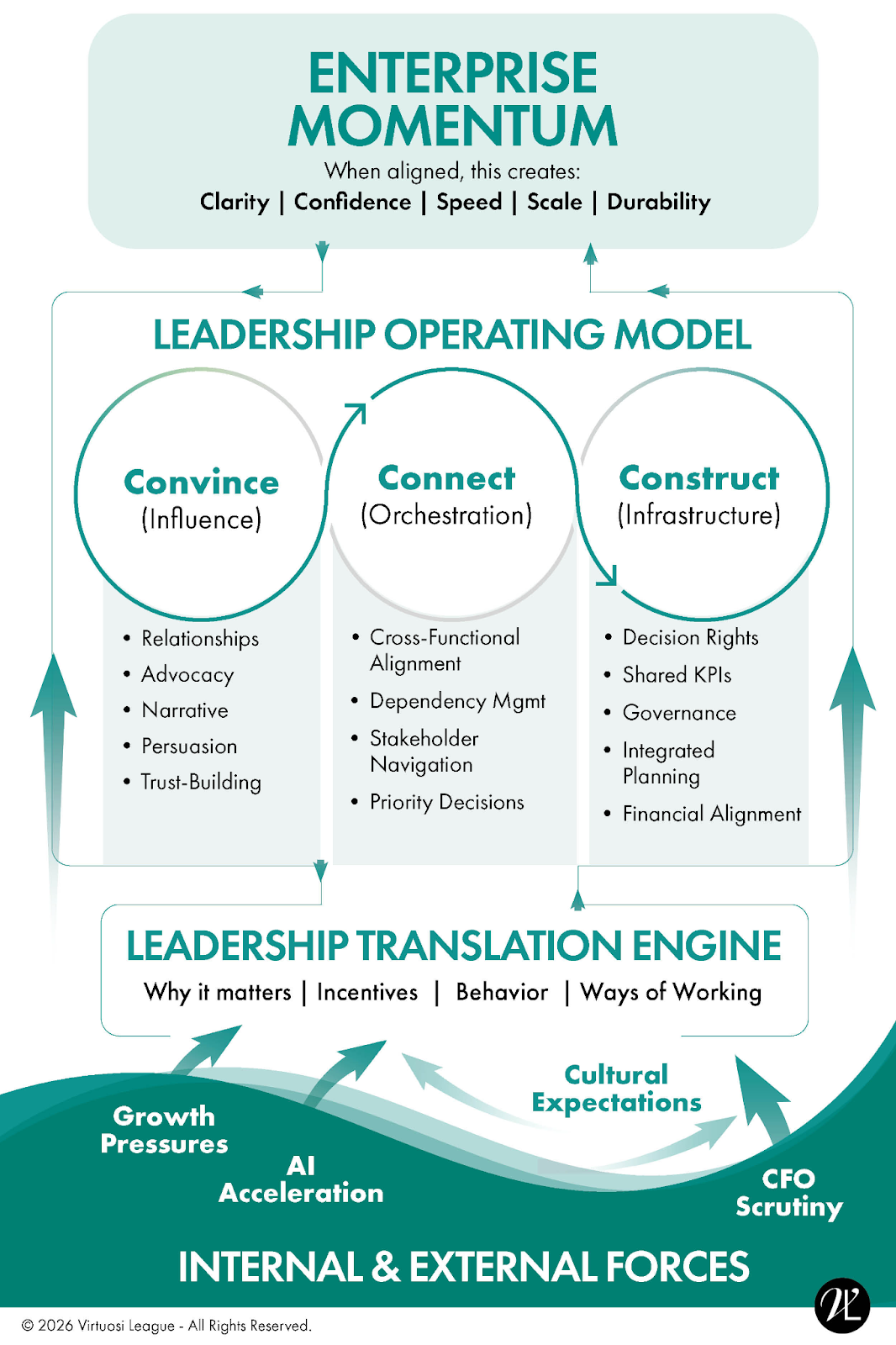
Enterprise momentum is shaped by how leaders align these connected layers across the organization.
When they align, work moves with speed, clarity, confidence, and scale. When they do not, friction appears and momentum slows.
The sections that follow break down:
- Where momentum stalls
- What builds momentum
- How to recognize signals early
Where Momentum Breaks (Diagnosis)
Friction tends to show up in consistent ways:
- Goals do not line up across functions
- Decision rights are unclear or assumed
- Strategy sounds clear, but execution drifts
- Short-term and long-term priorities compete
- Metrics are not shared
- What is said and what happens do not match
Most organizations recognize these dynamics. The opportunity is addressing them earlier and more intentionally.
Leadership Reflection
- Where are decision rights unclear in practice?
- Where are teams measured on functional success instead of shared outcomes?
- Where are critical enterprise decisions being made without the customer perspective you represent?
- Where are you waiting for alignment instead of helping create it?
- Where does ownership become unclear once work begins?
- Where might governance, incentives, or operating rhythms be slowing execution?
What Builds Momentum (Enablers)
When work gains momentum, several conditions tend to emerge:
- A shared goal that carries weight across functions
- Clarity on who decides what
- Continued leadership involvement beyond kickoff
- Consistent ways of measuring success
- Early engagement with Finance
- Governance that supports progress
Trust matters. Clarity and operating discipline turn trust into consistent movement.
Leadership Reflection
- Where are shared metrics missing?
- Where does sponsorship fade after the initial push?
- Where are decisions getting revisited instead of progressing?
- Where is process slowing work that could move faster?
- Do you have the coalition required to move enterprise priorities forward?
- Where does leadership conviction need to move ahead of full alignment?
How Momentum Shows Up Day to Day (Operating Reality)
In organizations where momentum builds consistently:
- Leadership teams operate as a true enterprise first team
- Shared scorecards complement functional metrics
- Planning happens across functions
- Ownership is clear across teams
- There is shared understanding of how value is created
Momentum becomes less about alignment conversations and more about how work moves consistently across the system.
Leadership Reflection
- How are decisions made across teams in practice?
- Where is ownership unclear once execution begins?
- Where is the leadership team aligned in the room but less aligned in action?
- To what extent is the leadership team operating as a true first team?
- Where does planning still happen in silos?
- Where is complexity being absorbed at the leadership level, and where is it cascading into the organization?
- Where do core processes need to be strengthened to create consistency?
- Where do leaders need to empower teams to move faster?
Signals of Momentum
When work is moving:
- Decisions happen quickly
- Resources follow priorities
- Teams describe work in similar ways
- Leaders remain engaged
- Finance is aligned
- Teams lean in without being asked
When work slows:
- Decisions are revisited repeatedly
- Resources do not align with priorities
- Leadership involvement becomes uneven
- Ownership is unclear
- Energy concentrates at the top rather than spreading
What This Means for Leaders
As growth becomes more interconnected, leadership is less about owning every lever and more about orchestrating how they connect. Leaders increasingly shape how priorities align, how decisions are made, and how work moves across the enterprise.
Leaders also act as a translation layer, interpreting internal and external forces and helping those priorities move across the organization.
Leaders who create momentum shape how work moves, not just what outcomes are pursued.
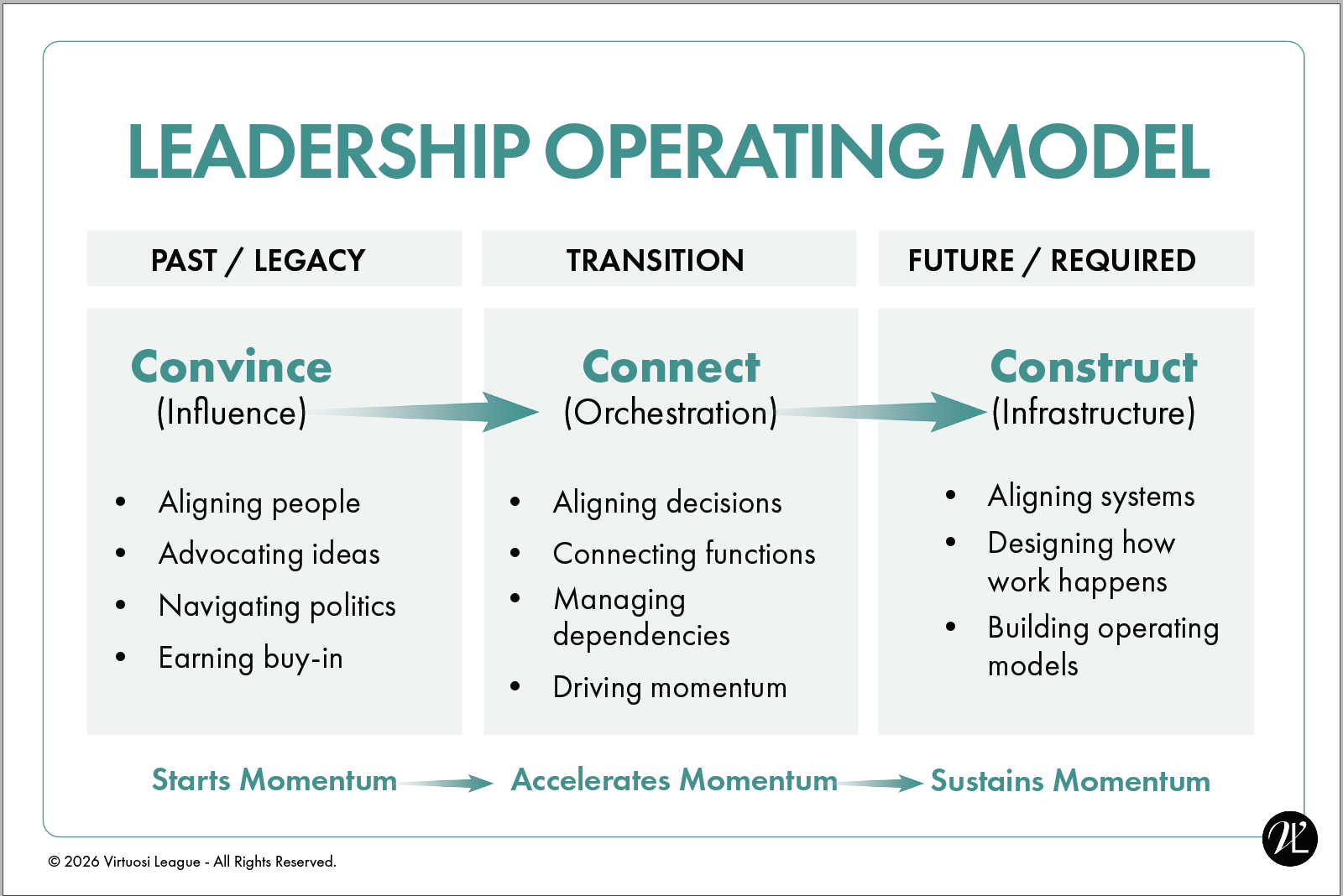
The Leadership Operating Model
If the Enterprise Momentum Model helps leaders see where momentum builds or breaks, the Leadership Operating Model focuses on how leaders must operate differently to create sustained momentum.
Together, they connect enterprise conditions with leadership behavior.
Maturity Lens: A Practical Way to Gauge Where You Are
Across organizations, a few patterns tend to emerge:
Level 1: Fragmented
Reactive, siloed, inconsistent
Level 2: Emerging
Some alignment, inconsistent execution
Level 3: Integrated
Clear structures, repeatable progress
Level 4: Adaptive
Fast learning, system evolves continuously
Most organizations show a mix of these patterns. The value comes from seeing more clearly where momentum is building and where leadership attention can accelerate progress.
Final Thoughts
This phase of the Leadership Field Guide focuses on what makes progress possible.
You now have:
- A way to see how enterprise momentum is built
- A way to recognize where it slows or breaks
- A set of questions to assess where you stand
Across organizations, one pattern is consistent:
Strategy is rarely the constraint. Momentum is.
The leaders creating the most progress are not waiting for perfect clarity. They are shaping the conditions that allow work to move.
That is the shift. From influence to infrastructure.
Review the Insights for Theme 1: Enterprise Leadership in an Era of Transformation