.png?width=2586&height=283&name=VL_LockupHorizontalReverse%20(1).png "Virtuosi League logo")

The Catalyst
Every leader has experienced a version of this frustration: Two talented people receive the same assignment, the same level of support, and the same expectations, yet they produce dramatically different results. One thrives under the challenge while the other struggles to gain traction.
For many leaders, the instinct is to double down on the leadership style that served them well throughout their career and apply it equally across their team. But Vineet Mehra, Chief Growth and Marketing Officer at Chime, believes this is where many challenges begin. Speaking to a recent LEAP Essentials class, he argued that the strongest leaders strive for consistency in how they diagnose situations before deciding how to lead within them.
His situational leadership approach provides a practical framework for making that diagnosis. Rather than assuming every person needs the same level of direction or autonomy, leaders evaluate the work and the individual before deciding how to respond. The result is stronger performance today and more intentional development over time, as well as greater operating leverage and ability to scale teams.
The Approach
When performance slips, the natural instinct is to help. Leaders offer advice, increase oversight, or step in to solve the problem because they want their teams to succeed. Vineet encourages a different starting point: understanding why performance differs from expectations.
He recommends beginning with three simple questions:
- What is happening today?
- What should be happening instead?
- Where is the gap between those two realities?
Those questions shift attention away from symptoms and toward the underlying challenge.
Diagnose the Task Before the Person
Many leadership conversations begin by evaluating the employee. Vineet encourages leaders to reverse that order and first understand the task itself.
Every assignment carries different demands. Some require careful judgment and cross-functional influence. Others depend on speed, precision, technical expertise, or collaboration. Before deciding how much guidance to provide, leaders should understand what success requires and what the work demands of the individual.
Once the task is clear, they can evaluate the person against that specific challenge. This distinction is important because people do not occupy one permanent leadership category. Someone who confidently leads a marketing campaign may need much more support when presenting to investors for the first time. Likewise, an experienced executive can become a beginner again when entering a new functional area.
Assess Competence and Confidence Separately
After understanding the task, Vineet asks leaders to assess two independent dimensions: competence and confidence.
Competence reflects whether someone has the knowledge, experience, and skill required to complete the work successfully. Confidence reflects whether they believe they can succeed and are prepared to take ownership of the outcome. To complicate matters, these qualities often develop at different rates. Someone may possess the technical ability to succeed while still hesitating to make important decisions, while another person may approach a new assignment with enthusiasm despite lacking the experience to recognize its complexity.
Viewing competence and confidence independently gives leaders a clearer understanding of what kind of support will help someone succeed and continue developing.
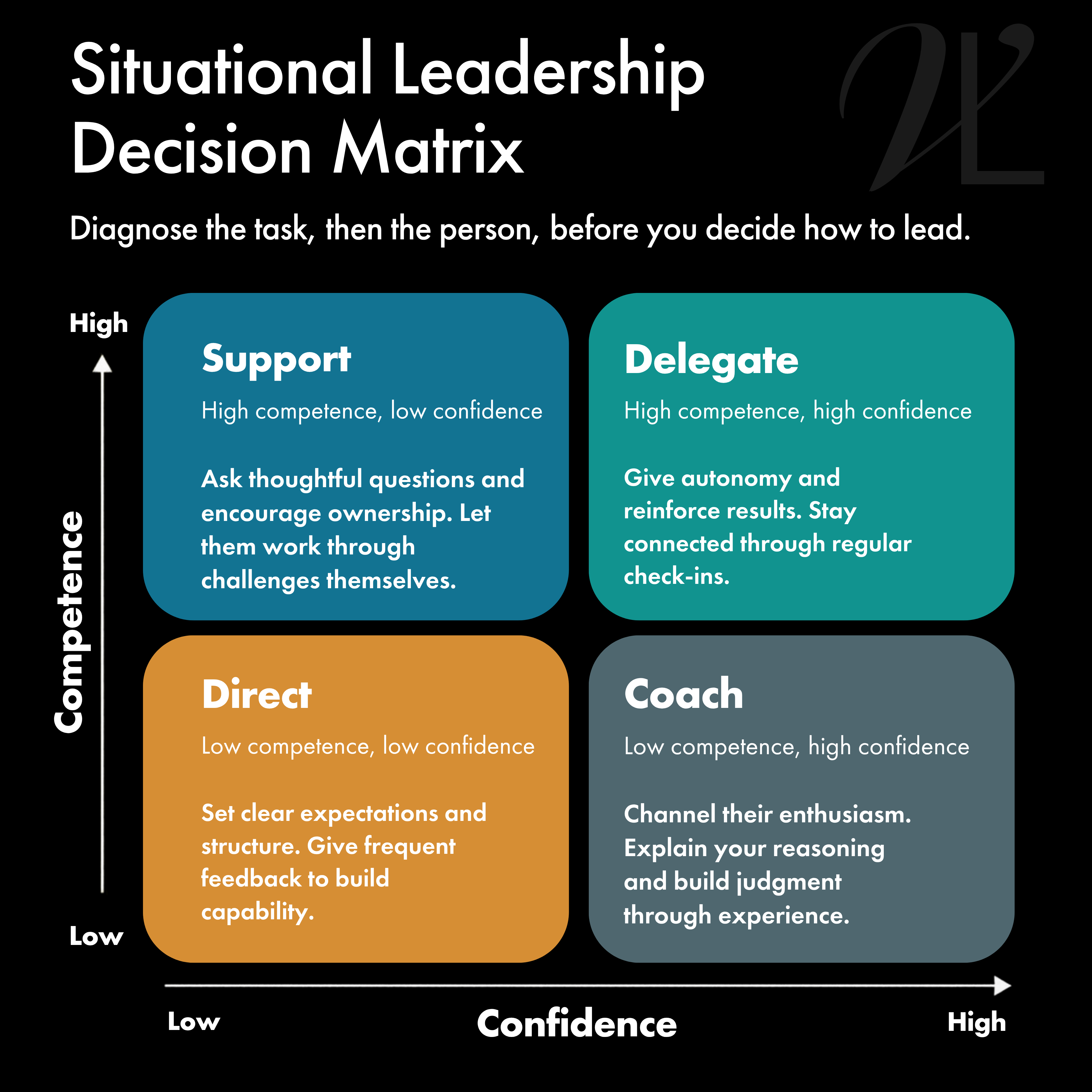
Diagnose the Situation
Once leaders understand both the task and the individual, they can determine which leadership approach best fits the situation. Vineet's interpretation of this framework maps every assignment across competence and confidence, creating four distinct leadership responses. Rather than applying the same style to every employee, leaders adjust their approach to match both the work and the person.
Match Your Leadership Style to the Situation
The framework is designed to help leaders adjust their style as people grow. Someone who needs detailed direction on one assignment may be ready for coaching on the next. As competence increases, the role of the leader shifts from providing answers to asking better questions. As confidence grows, support gradually gives way to greater ownership and autonomy.
Vineet challenged leaders to rethink their aversion to a direct leadership style, arguing that the fear of micromanaging often gets in the way of giving people what they actually need. If someone has low competence and low confidence for a specific task, they need direction. That direction only becomes frustrating when it stops matching what the person actually needs. As he explained, "It's only micromanagement when there's a mismatch between what that person needs and what you're offering them."
The same principle applies at the other end of the spectrum. While stepping in too quickly can prevent capable employees from developing confidence, delegating too early can overwhelm someone who still needs coaching. Vineet encouraged leaders to "hold in the answer" when supporting experienced team members, because solving the problem yourself may get you through today while limiting someone's long-term growth.
Develop People Through the Work
One of the most practical aspects of Vineet's framework is that development happens inside the work rather than outside of it. Every assignment becomes an opportunity to build new capabilities, strengthen judgment, and increase confidence.
As an example, Vineet used a personal and relatable story: teaching his son to ride a bike. He started by providing complete guidance, gradually reduced his support as confidence grew, and eventually reached a point where his son could ride independently. Leadership follows a similar progression. As people gain experience, they move from directing to coaching, from coaching to supporting, and ultimately toward delegation. It may appear simple but isn’t easy.
The Takeaway
Delivering business results will always remain essential, but leadership carries another responsibility: increasing the capability of the people doing the work so the team becomes stronger and can scale over time.
"Your job as a leader is not just to get the job done,” Vineet said. “Your job is to get the results while developing your people so that you get leverage over time."
Leaders who consistently diagnose before they decide create teams that become more capable with every assignment. Instead of relying solely on one preferred leadership style, they learn to shift between directing, coaching, supporting, and delegating as people and situations evolve.
"Great leadership is not about having one style,” Vineet said. “it is about knowing when to use each one."
About Vineet Mehra

Vineet Mehra is a globally recognized marketing leader whose career spans CPG, tech, and direct-to-consumer innovation. As Chief Growth and Marketing Officer at Chime and former Global CMO of Walgreens Boots Alliance, Ancestry, and youngest President at Johnson & Johnson, he is known for blending brand building with performance discipline. Today, he serves on multiple boards, advises high-growth companies, and champions leadership development through practical, people-centered frameworks.