.png?width=2586&height=283&name=VL_LockupHorizontalReverse%20(1).png "Virtuosi League logo")


The Shift
For years, growth followed a familiar rhythm.
Build the strategy.
Launch the work.
Optimize performance.
Repeat.
This was never simple. Great leaders have long managed complex growth ecosystems spanning brand, demand, retention, and customer experience. But the underlying rhythm of how growth was planned, measured, and scaled felt more stable.
While that rhythm has been evolving for some time, recent shifts are accelerating the pace of change. That acceleration creates new opportunity to rethink how durable growth is built.
Growth today is shaped by fragmented discovery, AI-mediated influence, shifting customer journeys, and rising enterprise expectations, all happening at once. These forces are reshaping how leaders design, enable, and scale growth across the enterprise.
But the fundamentals of growth have not changed. Organizations are still working toward sustained growth, stronger customer relationships, greater enterprise alignment, shared measures of success, and competitive differentiation.
What is changing is how growth is designed and sustained.
Through our Executive Roundtables and ongoing conversations with leaders, a clear shift is taking shape.
Leaders are moving beyond individual initiatives and functional boundaries to examine how growth actually works across their organizations.
That shift is driving a broader rethink of how growth is designed, aligned, and sustained. Durable growth has always depended on alignment across the enterprise. Now, organizations are beginning to design for that alignment more intentionally.
The Durable Growth Architecture
As leaders work across these challenges, growth is evolving across multiple dimensions at once: ownership, planning, measurement, operating models, and sources of competitive advantage. These elements are shifting simultaneously, not sequentially, with some advancing quickly while others remain anchored in legacy approaches.
As a result, growth is becoming more interconnected and more dependent on how these elements work together across the enterprise.
Taken together, these dynamics form what we refer to as The Durable Growth Architecture.
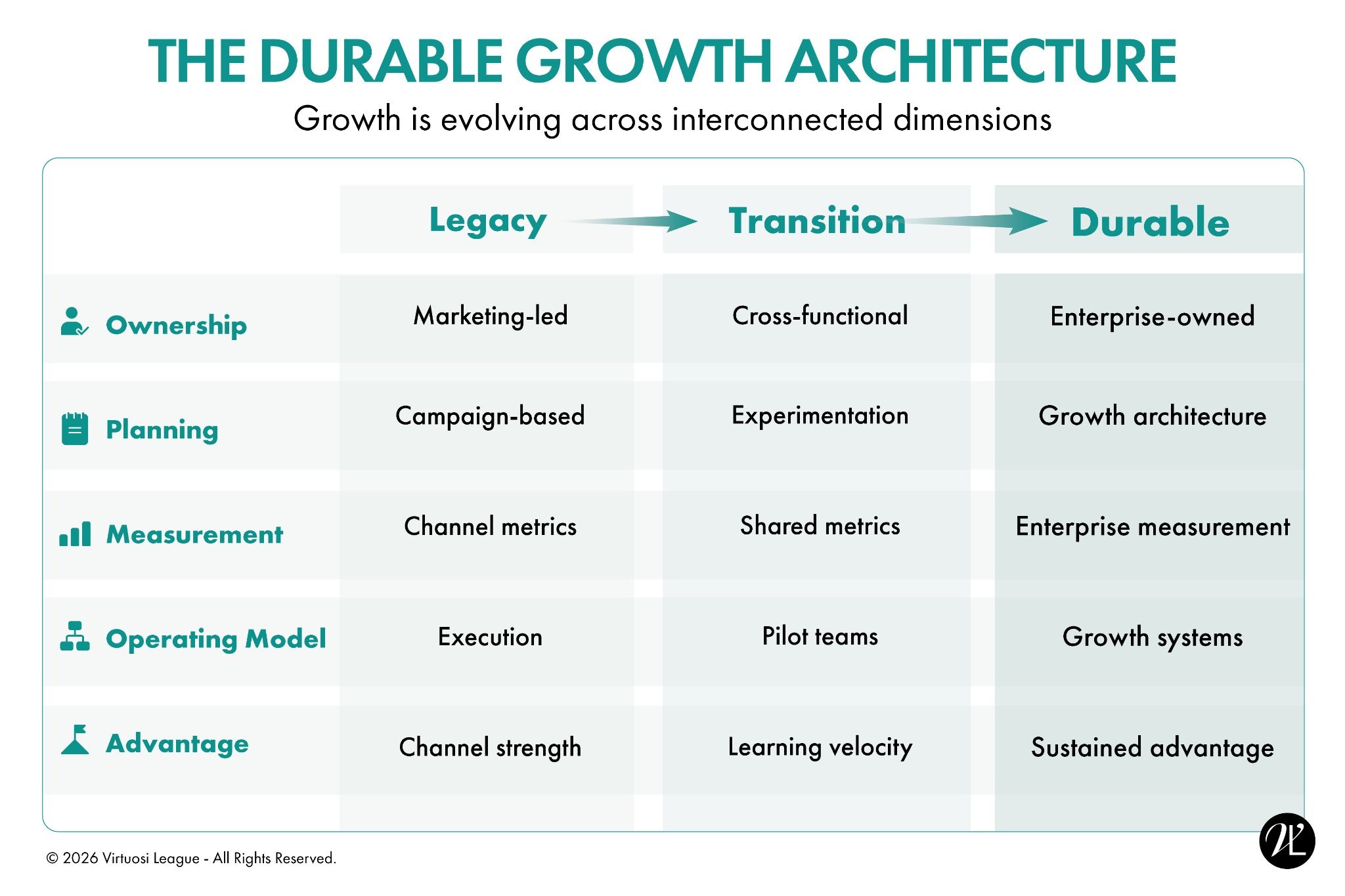
Where Growth Is Taking Shape
Each of these dimensions is advancing at a different pace. Together, they begin to reshape how durable growth is built.
Growth Ownership
Ownership of growth is expanding beyond marketing to become a broader enterprise responsibility.
This shift changes how priorities are set, how decisions are made, and how teams collaborate. Growth gains momentum when it is owned across the enterprise, creating new opportunities for collaboration, alignment, and scale.
Leadership Reflection
As these shifts take shape, ask yourself:
- Who across the enterprise truly owns growth, and where is that ownership fragmented?
- Is there a shared understanding of how growth works across functions?
- Where are cross-functional misalignments slowing execution?
Growth Planning
Campaign planning is giving way to continuous experimentation and cross-functional growth design.
Rather than waiting for perfect strategies, organizations are testing, learning, and adapting in real time. Growth becomes less episodic and more embedded in how organizations operate.
Leadership Reflection
- How quickly can new growth ideas move from insight to real-world testing?
- How is content being used as a real-time signal for learning, not just as an output of campaigns?
- Where is learning velocity treated as a competitive advantage?
- Where might leaders be waiting for performance signals instead of placing informed bets earlier?
Measurement & Accountability
Measurement is evolving as discovery fragments and attribution becomes harder to isolate. This is prompting a shift toward shared metrics, broader accountability, and a more enterprise-level view of growth.
Leadership Reflection
- Where are measurement choices being shaped by visibility and accessibility, rather than leadership conviction about what truly drives growth?
- What signals determine whether an initiative scales, evolves, or stops?
- Where might limited visibility into customer journeys be creating false confidence?
Growth Operating Model
Growth is shifting from campaigns to systems.
This includes cross-functional teams, AI-enabled experimentation, and new approaches to how demand is generated and captured. Growth becomes less episodic and more embedded in how organizations operate.
Leadership Reflection
- Where are structural constraints being accepted as strategy rather than challenged as barriers to change?
- Where are legacy marketing structures slowing experimentation?
- Where might teams be optimizing existing channels instead of rethinking the growth system itself?
- Where could a small, focused experiment reveal more than months of planning?
Competitive Advantage
Competitive advantage is becoming harder to sustain through individual tactics alone.
Global competition, uneven data access, and evolving regulatory environments are further reshaping how advantage is built and sustained.
Durable growth depends more on enterprise capability, a global view, brand strength, learning velocity, and organizational alignment.
Leadership Reflection
- How should investment shift if brand increasingly shapes discovery, trust, and algorithmic visibility?
- Is brand being treated as a continuous operating asset or as episodic storytelling?
- Where must judgment, taste, and storytelling remain central, even as AI reshapes execution?
- Where might a lack of attention to global signals be limiting growth thinking, innovation, or competitive edge?
Maturity Lens: A Simple Way to Gauge Where You Are
This maturity lens builds on the framework introduced in Theme 1 (From Influence to Infrastructure), now applied to how organizations design durable growth.
The Durable Growth Architecture is not something organizations build all at once. Most organizations are already somewhere along this path.
That creates a practical question for leaders: Where are we today, and what might be holding us back?
Level 1: Fragmented
Reactive, siloed, inconsistent
Growth is largely campaign-driven and functionally owned.
Efforts may generate momentum, but progress can be inconsistent or dependent on individual initiatives.
Common signals:
- Growth owned primarily within marketing
- Teams operating with different assumptions about growth
- Measurement focused on channel performance vs. enterprise outcomes
- Limited cross-functional planning or coordination
- Experimentation constrained by structure or risk tolerance
Level 2: Emerging
Some alignment, inconsistent execution
Organizations begin to recognize that growth requires broader alignment.
Cross-functional initiatives emerge, but execution is uneven.
This stage often signals meaningful progress, even if consistency is still evolving.
Common signals:
- Cross-functional growth initiatives or pilots
- Increased collaboration between marketing, product, and finance
- Experimentation becoming more common, but not yet structured
- Early discussions around shared growth metrics
- Growth ownership still shifting or unclear
Level 3: Integrated
Clear structures, repeatable progress
Growth is being designed across the enterprise.
Ownership is clearer and execution becomes more consistent.
Common signals:
- Cross-functional growth planning
- Shared growth KPIs across functions
- Defined experimentation frameworks
- Alignment between marketing, product, finance, and technology
- Growth initiatives scaling more consistently
Level 4: Adaptive
Fast learning, system evolves continuously
Growth becomes embedded in how the organization operates.
Learning velocity increases and systems evolve continuously.
At this stage, growth becomes more resilient, adaptable, and capable of sustaining advantage over time.
Common signals:
- Continuous experimentation and learning
- Enterprise-wide ownership of growth
- AI-enabled growth workflows
- Rapid testing and scaling across functions
- Durable competitive advantage driven by capability and alignment
Final Thoughts
The fundamentals of growth haven’t changed. But the way growth is built has.
Campaigns still matter. Performance still matters. More often, they are outcomes of something deeper.
Durable growth is becoming less about what organizations launch and more about what they build.
The architecture is still emerging. But the shift is already underway and leaders are actively shaping what comes next.
Organizations that recognize this shift, and begin building accordingly, will be better positioned to create durable advantage in an environment defined by ongoing uncertainty.
Review the Insights for Theme 3: Redefining Growth and Marketing Fundamentals