.png?width=2586&height=283&name=VL_LockupHorizontalReverse%20(1).png "Virtuosi League logo")

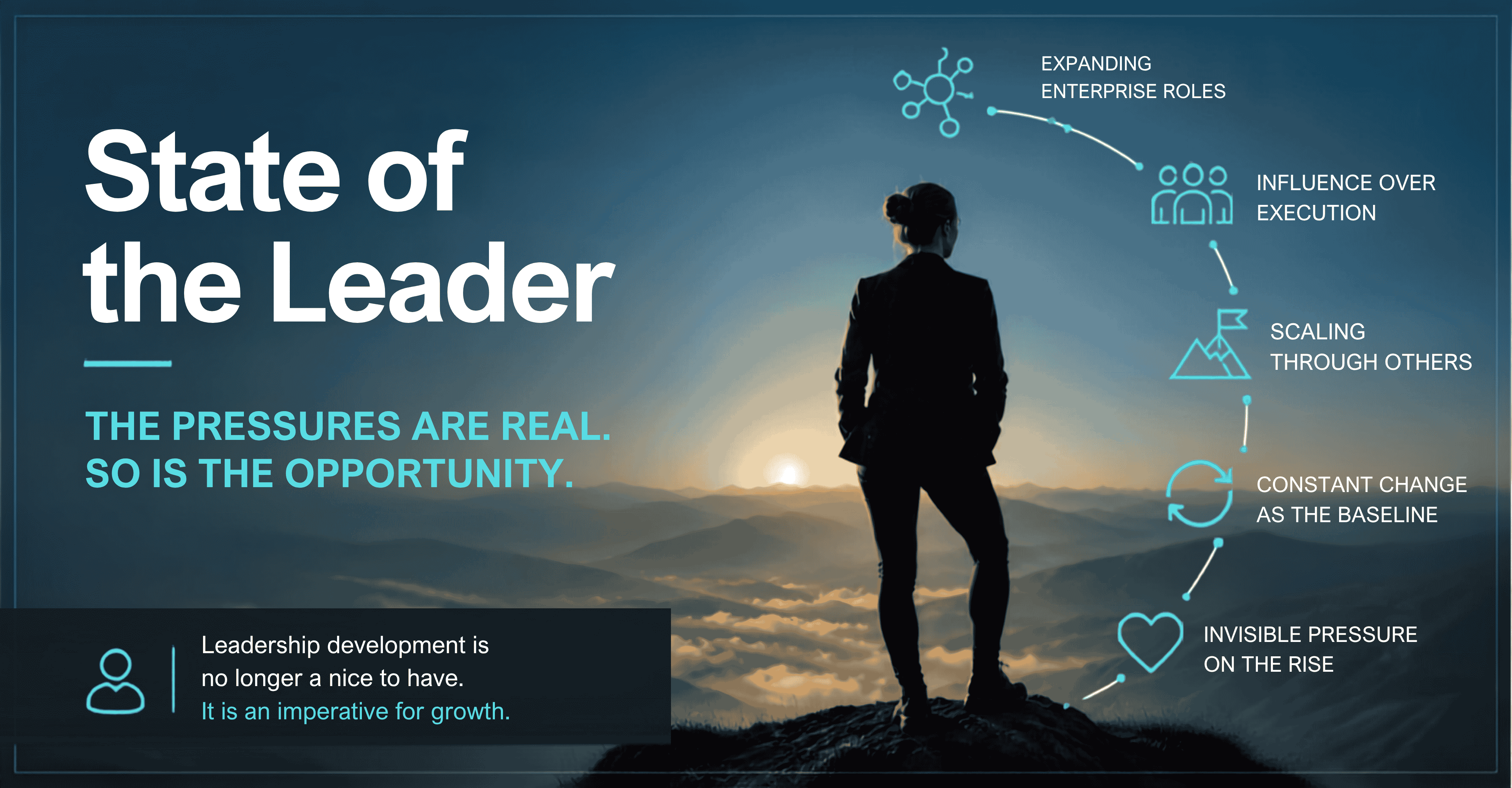
What defines good, better, or great leadership is evolving quickly, and connecting with peers facing the same challenges is the best way to stay ahead of the game and on point for our teams. For example, adaptability and self-awareness, once considered soft skills, are non-negotiable hallmarks of good leadership, all the way to the top.
As part of our Spring 2026 LEAP Flagship cohort, we brought together three powerful voices to explore the demands of leadership in our current moment.
Rishad Tobaccowala (Author, Futurist, former Chief Strategist, Publicis Groupe) shared context for the external disruption facing leaders today, while Antonio Lucio (EVP and Chief Marketing and Corporate Affairs Officer at PayPal) and Tiffany R. Warren (EVP, CDIO, Sony Music Group; Founder and President, ADCOLOR), focused on the internal discipline required to lead through that disruption with clarity and purpose.
The through-line connecting it all: Leadership today requires courage, clarity, and deep humanity. The future will reward leaders who combine adaptability with clarity, within themselves and for their teams.

Part 1: Navigating External Disruption
Rishad opened his session with a powerful reminder that the structure of work itself is fundamentally shifting. His message was a call to recognize what's happening.
He estimated that 68 percent of people earn income outside of their full-time job, and that full-time jobs are likely to further decline with the rise of AI agent "employees," fractionalized workers, and portfolio careers. The implications are immediate: "Many people on your teams already have side hustles and think of you more like venture capital than a lifelong employer," Rishad said.
He advised leaders to shift from managing roles to cultivating the craft that defined those roles in the first place. In this way, growing talent becomes even more of a competitive advantage.
As AI continues its exponential impact on the workplace, knowledge becomes less valuable and experience less rare, as Rishad put it. But therein also lies the opportunity: "As intelligence becomes abundant, distinctly human capabilities increase in value," which includes judgement, trust, influence, creativity, and nuanced decision-making.
Leadership in the Zone of Influence
Where managers run in the zone of control, Rishad argues that leaders must operate from the zone of influence. We've seen this guidance come up time and again in our community, where credibility is a bridge to influence and impact, and influence informs the infrastructure for enterprise transformation. While it may seem counterintuitive, controlling does not increase influence.
Control means checking, measuring, and managing, but influence means inspiring, building, shaping what's next. "Look at your calendar," he urged, "and if you spend 70-80% of your time checking in, monitoring, measuring, reporting, make that less than half. You still have to do that, it's part of your job. But that part is the machine part. Don't make your entire job all machine...machinable."
His point: spend at least 50 percent of your time on making, creating, inspiring, selling, or building. That's where leaders create value, and it's the part most people enjoy anyway. His practical recommendations:
- Take one hour a day to learn. "Take it from anywhere but from family and self."
- Build the case for the opposite of what you're currently building
- Choose pragmatic optimism. In uncertainty, people look to leaders for stabilizing hope.
"Companies don't transform, people do," Rishad says. Individual growth is the mechanism of organizational change.
Part 2: Sharpening Internal Discipline
As Rishad showed us the external landscape of leadership, Antonio and Tiffany brought us back to the internal discipline of the practice: the clarity, values, and self-leadership required to navigate disruption.
Purpose and Values as Anchors
Antonio reframed purpose clearly: "Purpose is not a what, it is a how."
Authentic leadership begins with clarity about what you value, what steers your decisions, and what your non-negotiables are: "owning the size of the shadow that you cast," as Antonio put it. Every action sends a signal, whether you intended it to or not.
Tiffany emphasized the discipline required: "Get brutally clear on what you stand for. Your values can't be aspirational or performative slogans. They have to really mean something to you when you say it."
What Leaders Actually Control
In times of volatility, Antonio offered three anchors:
- You cannot control uncertainty, but you can control clarity
- Provide context to help teams make sense of mixed signals
- Hope is a choice. "The faith that if you do what you are committed to do with your teams and community, we can affect change."
These are leadership disciplines that stabilize teams when everything else is shifting.
Tiffany emphasized the importance of protecting what matters most to fully show up as a leader.
"I create spaces where I'm not the leader, because I do think you need a space where you're not the boss," she said, explaining how she shields these spaces with family, friends, or her community that are free of the weight of leadership. "I'm not being evaluated other than being a sister, being a partner, being a daughter."
This practice helps Tiffany with the difficult work of holding complexity. Leaders often carry uncertainty, doubt, and emotional weight that cannot always be processed immediately or shared openly with their teams. But she describes herself as very comfortable "holding the weight of leadership without immediately releasing it."
"Some decisions come with doubts and fears that don’t resolve quickly," she said. "I understand how to carry that weight while still moving forward."
Emotional Hygiene and Self-Care
Tiffany spoke candidly about emotional well-being: "I don't expect my team to be my emotional mirror. I have to be my own emotional mirror."
She's ruthless about protecting well-being, from surface-level facials and workouts, to the deeper ones that are harder to articulate: emotional hygiene, energy cleansing, auditing the emotions she takes in. When leaders model these behaviors for their team, it makes it safe for them to do, too.
Antonio echoed this from painful experience: "Taking care of yourself is the most generous thing that you can do for the ones that you love and those people that you care about." He didn't learn this until after falling into depression: without a peer set outside his company, without a mentor, without cultivated friendships. His recommendation to combat this is to build multiple support structures:
- A peer group outside your company (like the LEAP Flagship cohort)
- A mentor with no fiduciary responsibility to your organization
- A sponsor inside your company who helps you grow
- Friends who know the good, bad, ugly, and extraordinary of you
Authentic Leadership vs. Being Your "Authentic Self"
Antonio clarified a critical distinction: authentic leadership doesn’t mean never adjusting your style. "As long as you're operating with your values, and as long as you know exactly what you're here to do, you're going to flex and navigate to get that thing done."
He used his family as an example: five daughters, all different people with approaches to life. "If we want to get something collectively done, my style is going to have to be modified to each one of them, and I'm still not lying to any of them."
The Takeaways
Leadership in disruption requires:
- Moving from a zone of control to a zone of influence
- Choosing pragmatic optimism over fear
- Providing clarity and context in times of uncertainty
- Being flexible in your approach while remaining true to yourself.
- Viewing work as not your purpose, but rather a canvas for your purpose to unfold
- Establishing strong values and non-negotiables that anchor your decisions
- Protecting spaces where you are not the leader to sustain emotional resilience
- Reflecting frequently, because self-evaluation refines your evolving purpose
The external world will remain exactly that: external to what we can control. But our values, discipline, and the self-awareness stabilize us in the swirl.
The leaders who will thrive in this next era are the ones who combine external awareness with internal clarity; these are leaders who can navigate disruption while strengthening the trust, resilience, and humanity of the people around them.
10 Things Great Leaders Do (According to the People They Lead)

26 Leadership Insights from Top CMOs