.png?width=2586&height=283&name=VL_LockupHorizontalReverse%20(1).png "Virtuosi League logo")


For all the air time AI gets, most leaders are still asking the wrong question: "Are we doing AI?"
It's an urgent question being asked across boardrooms, executive meetings, and strategy sessions around the world. Yet beneath the urgency lies a dangerous assumption: that adopting AI is itself the goal.
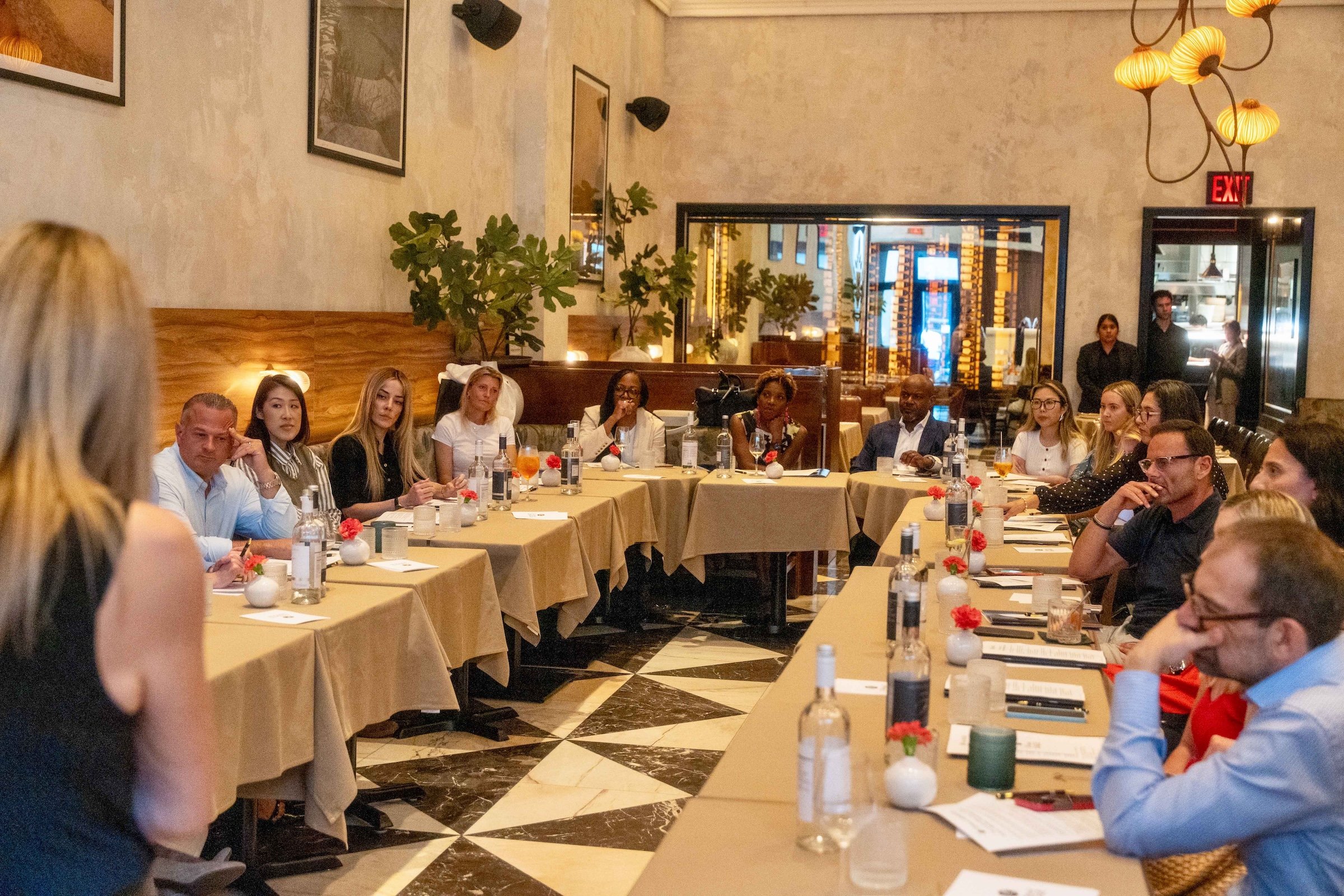
At our recent events in New York, leaders across industries came together to discuss what it really takes to lead through the AI era. The day kicked off with a panel discussion led by Arthur Sadoun, CEO of Publicis Groupe; Leslie Berland, CMO of Verizon; and Seth Dallaire, EVP and Chief Growth Officer of Walmart, transitioned into our Executive Roundtable: Human + Machine: Redefining Culture, which featured dozens of leaders in the Virtuosi League community, and then capped with Dinner with Friends.
The conversations weren’t just about AI; they were also about culture, leadership, organizational design, the future of human work, and the imperative for leaders to inspire teams to walk the path with us. While technology may be accelerating change, leadership determines whether organizations can successfully navigate it.
The organizations making the most progress create clarity amid uncertainty, helping employees build new capabilities, strengthen trust across teams, and maintain a clear connection between business transformation and human experience.
The Efficiency Trap
Much of today's AI narrative is shaped by headlines focused on speed, efficiency, and cost reduction, which pleases boards and investors the most. Executives feel pressure to move quickly. But the byproduct of that speed is narrow framing and problematic consequences.
When organizations focus exclusively on efficiency, AI becomes a layer on existing workflows without questioning whether those workflows make sense in the first place. This only enables inefficient processes to multiply and move faster.
This explains why so many companies remain stuck at the task level. Teams use AI to summarize meetings, write content, automate reports, or streamline workflows. Valuable gains, certainly. But incremental gains nonetheless.
True transformation requires leaders to ask a different question: What problem are we actually trying to solve with this technology?
The Growing Leadership Gap
One of the most consistent themes emerging across organizations is a widening disconnect between leadership layers. For example, boards discuss AI strategy, executives focus on operating models, and employees are anxious about their jobs and career paths. Not to mention the generational disconnect woven through all of these groups: entry-level Gen Z through the offramping Generation X.
The disconnect between groups and generations creates uncertainty, and uncertainty feeds fear.
Many employees are navigating role changes, shifting expectations, and rapid technological advances while carrying significant personal, professional, and existential pressures. Yet performance systems, management practices, and organizational cultures have not evolved at the same pace.
No one can force anyone to do anything. But the best leaders help people navigate profound change without losing trust, confidence, or purpose, and drive business transformation.
Employee Experience Is Customer Experience
Another theme surfaced repeatedly: employee experience and customer experience must become the same conversation.
Leaders across industries all pointed to the impact of the disconnect between organizational culture and customer outcomes. For companies with large frontline workforces, this is especially visible, if some employees can work remotely while others show up every day to serve customers, operate stores, and deliver experiences in person. When corporate culture becomes disconnected from those realities, customers feel it, too.
What’s inside eventually comes out, and we can no longer think of culture as an internal concern. It shows up in service, trust, responsiveness, creativity, and brand perception. Increasingly, employee sentiment becomes consumer sentiment, too.
The Gen Z Conversation Is Really a Leadership Conversation
Few topics generated more energy than the next generation of talent.
Many executives acknowledged frustration with the prevailing narratives around Gen Z, particularly the assumption that younger workers lack commitment, resilience, or ambition. One participant observed that many rising in the workplace might even view their roles as “VC for their side hustle;” said not with judgement, but honesty about the disconnect between what younger employees do to pay bills and what they want to do for fulfillment. But the conversation quickly moved beyond stereotypes.
Several leaders argued in support of younger employees, who seemingly want to articulate real needs, but lack the language or frameworks to express them clearly. When they ask for purpose, authenticity, flexibility, growth, or balance, leaders in turn might hear buzzwords instead of the underlying concern.
Others noted that many younger professionals entered the workforce during a period of extraordinary disruption. Their expectations have been shaped by different economic, social, and technological realities than those of previous generations.
What became clear is that this is not simply a Gen Z issue. It is a leadership issue.
Developing talent has always required mentorship, coaching, context, and guidance. Yet many organizations have weakened those capabilities, particularly in the middle layers of management where much of that development traditionally occurs. The question is not how to manage a generation differently, but rather how to build organizations that help people develop the skills, judgment, confidence, and resilience required to succeed in a rapidly changing world.
Moving Beyond AI Adoption to AI Intentionality
The leaders who appear furthest ahead are not necessarily using the most AI. Rather, they are operating with the most clarity about what AI is meant to do for their people, customers, and the business.
As AI capabilities expand, nearly everything starts to feel possible. Ironically, that abundance creates a new problem: lack of focus. The most grounded leaders are not chasing every use case. They are identifying the handful of opportunities that can meaningfully move the business forward.
Here, efficiency becomes a byproduct rather than the end goal.


A New Moment for Marketing
Several leaders argued that this moment represents one of the biggest opportunities marketing has seen in decades.
For years, marketers have imagined highly personalized, customer-centric experiences. Many of those ambitions were constrained by data access, technical dependencies, organizational complexity, and speed. AI is bringing some of those ambitions closer to reality. Marketers can now create, test, personalize, and optimize at a scale that once required far more time and technical support.
But the opportunity comes with a warning. Moving faster does not automatically mean moving better. Marketing leaders must balance speed with judgment, personalization with trust, and technological capability with brand integrity.
This is also why the CMO’s role is expanding. Increasingly, marketing sits at the confluence of employee sentiment, consumer trust, cultural relevance, customer experience, and business growth. That is not only a marketing mandate. It is a leadership mandate.
The Human Premium Is Rising
As AI becomes more capable, human connection becomes more valuable.
This was one of the most welcome insights across the day. Leaders repeatedly returned to the importance of judgment, taste, curiosity, empathy, nuance, and creative discernment. In a world flooded with synthetic content, those human qualities may become more important, not less.
The issue is not whether AI can create more, because it can and will. The issue facing leaders is whether what it creates is meaningful, differentiated, trustworthy, and useful.
There will be more content, more automation, more sameness, and more noise, making human discernment a strategic advantage. The leaders and teams who can ask better questions, challenge mediocre outputs, understand culture, interpret signals, and make thoughtful decisions will become increasingly valuable.
The future belongs to deeply curious generalists, creative thinkers, strong editors, empathetic leaders, and people who know how to combine human insight with machine capability.
What Must Be True for Organizations to Move Forward
Across the conversations, there were several common requirements for these big-sky ideas to become reality.
Leaders must become far more specific about the problems they are trying to solve. Education and alignment need to flow throughout the organization, not remain confined to the highest levels behind closed doors. Companies need stronger data foundations and clearer operating models around how AI learns to support the business. Employees need space to ask questions, admit uncertainty, and learn out in the open.
Most importantly, organizations need to address fear directly. Avoiding the hard parts of transformation doesn’t make people feel safe, it only increases anxiety. Trust and transparency go hand in hand, especially when the message is honest: change will be hard, mistakes will happen, and not everything will look the same six months from now.
But honesty does not have to be bleak. In fact, it can be energizing when paired with commitment, clarity, and a credible path forward.
The Real Leadership Imperative
If there was one defining takeaway from the day’s conversations, it’s that transformation at this level is a fundamentally human challenge.
The leaders generating the most optimism know that we’re cocreating the future together, speaking candidly about complexity while helping their organizations build the confidence and capability to move forward.
Organizations that succeed will not necessarily be those with the most advanced tech stack, but the ones that focus on helping their people adapt, learn, and grow alongside it. That asks a lot of our leaders, who must tell an honest but hopeful story, create opportunities for experimentation, and preserve curiosity, coaching, mentorship, and human connection even as automation expands.
Most importantly, they must recognize that culture is not separate from AI transformation. Culture is the mechanism through which any transformation happens. While AI may change how work gets done, leadership determines whether and how people come with it.
-2.jpg?width=800&height=450&name=Pillar%201%20blog%20flagship%20(1)-2.jpg)
Leading Through Disruption: How Leaders Build Clarity and Influence
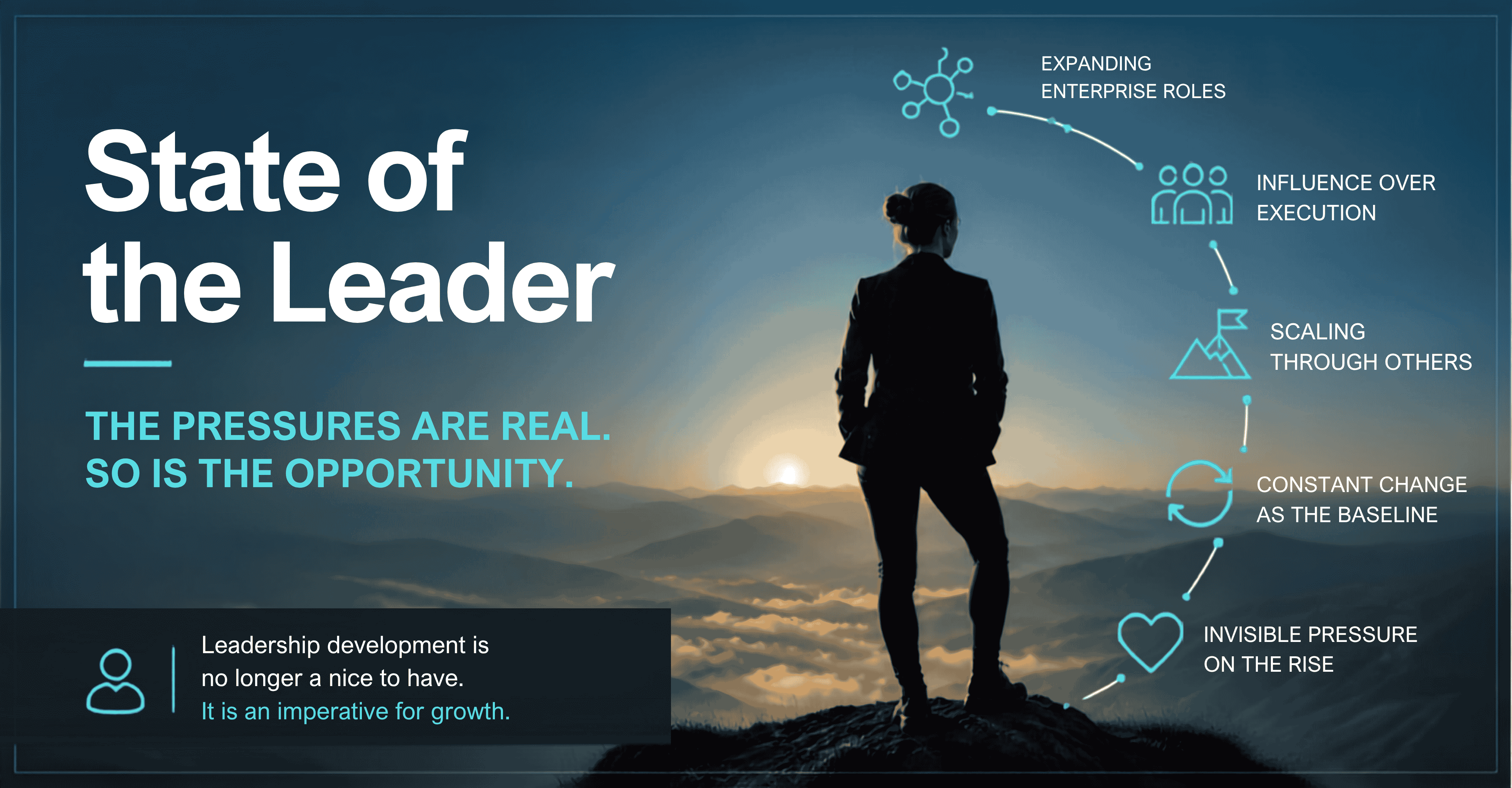
State of the Leader Report